
Key takeaways
- Three to five months is the realistic timeline for an ERP with several modules.
- The number of existing systems it must integrate with predicts the schedule better than the number of users or modules.
- Configure a product unless your processes genuinely do not fit one. Replacing everything at once is the most expensive version of an ERP project.
- Sometimes the problem is one process rather than the whole stack, and we will say so before you commission an ERP.
DECK IT, Ahmedabad, provides ERP consulting and implementation for businesses in India, Africa and the Middle East, bringing inventory, HR, accounting and CRM onto one platform, typically over 3–5 months. Various processes are essential in the running of a business. Inventory management, human resources, accounting, CRM etc. are few of the critical functions that have a bearing on the success of a business. Streamlining these operations is key to achieve operational efficiency. An Enterprise Resource Planning (ERP) solution integrates all these functions into a system that makes information accessible for various business operations. Globally, nearly 50 % of the companies are in the process of acquiring, upgrading or in the process of planning to upgrade their ERP systems. Nearly 53 % of the IT decision-makers feel that ERP is an investment priority along with CRM. Our Enterprise Resource Planning solutions are aimed at providing bespoke solutions for your specific business needs. Business efficiency helps in driving the profitability of the business. Manual processes, communication challenges between the various functions, access to information etc. are few of the complex challenges that affect the efficiency in the operations. Enterprise Resource Planning helps the organization, and more specifically, the employees to manage the jobs more efficiently by breaking down the barriers between different business functions. An ERP solution provides a holistic and real-time view of the data that can enable organizations to understand issues, address them proactively and drive changes. This would help in financial compliance and reduces the potential risks in the operations. Many of the core business operations that were handled manually and are repetitive in nature can be automated, thereby freeing up critical resources. ERP solutions further enhance the customer and user experience through easy access to information. We offer an extensive suite of ERP system that has its application across various functions. The single database architecture provides integrated interoperability and deeper access to the data. Any information that you would need to understand the state of business and to make business decisions is only a few clicks away. Using open-ended solutions like ERP-Odoo and other ERP tools, we develop a comprehensive ERP system that provides extensive functionality as well as a uniform look allowing for efficient and easy to use platform. The five flows a manufacturing ERP must cover first, the GST and job-work rules a Gujarat factory faces, and what to leave for later. AI earns its cost in an Indian SME where work is high-volume, repetitive and checkable: invoices, support tickets and management reports. Here is how to test each one. What ERP implementation really costs in India, the seven factors that move the number, hidden costs, and a worked first-year budget.
ERP Consulting and Implementation
How does an ERP add value to a business?
What does an integrated ERP implementation look like?
How do I start an ERP project?
What does DECK IT offer for ERP?
Connect with us for a Free Consultation
DECK IT’s engineers look forward to working with you.
Things we've written
ERP for a Manufacturing SME in Gujarat: What to Cover
Where AI Pays Off in an Indian SME
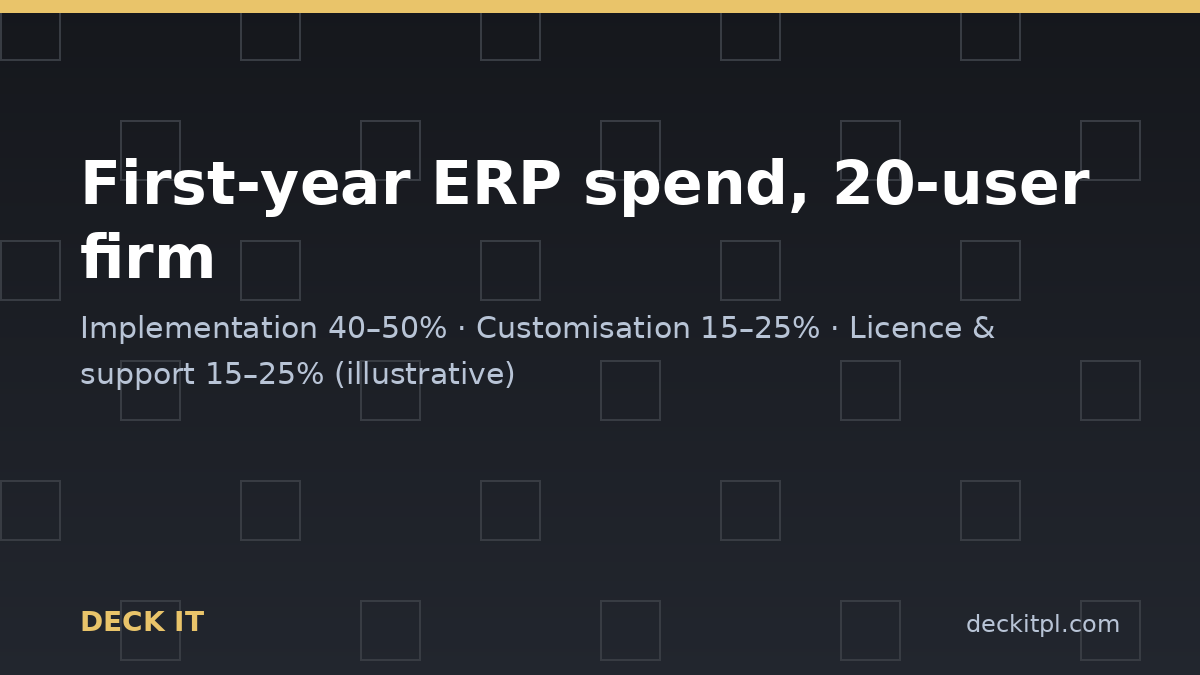
ERP Implementation Cost in India: What Moves It






Configure an ERP product or build one?
Configure a product, unless your workflow or industry rules make one fight you. Replacing everything at once is the most expensive version of an ERP project.
| Configure a product | Custom build | |
|---|---|---|
| Timeline | Two to four months of configuration | Three to five months |
| Cost | Licence plus configuration | ₹5–40 lakh for a defined scope |
| Your unusual process | You change the process | The system matches the process |
| Existing systems | Kept where connectors exist | Kept by design |
| Maintained by | The vendor | You, or us on a retainer |
Most companies should configure. The build is for workflows or industry rules that make a product fight you.
ERP projects: questions we get asked
How long does an ERP implementation take?
Three to five months for a system with several modules, which is what most ERP projects are. The number of existing systems it has to integrate with predicts the timeline better than the number of users or modules.
What does an ERP project cost?
Most projects we quote fall between ₹5 lakh and ₹40 lakh, roughly $6,000 to $50,000, as a fixed price for a defined scope, or a monthly rate for ongoing work. ERP projects tend toward the upper half of that because of the integration work.
Should we configure a product or build an ERP?
Configure, unless your processes genuinely do not fit one. A product is cheaper to start and somebody else maintains it. A build earns its cost when your workflow, industry rules or existing systems make a product fight you — and a development company telling you to build without asking that question first is selling.
Can an ERP keep the systems we already run?
Usually yes, and that is often the cheaper path. Replacing everything at once is the most expensive version of an ERP project. Tell us which systems have to stay and we will scope around them.
How do we start?
Send a few lines about what you run today and what is not working. We reply within a working day with an honest view of whether an ERP is the right answer at all — sometimes the problem is one process, not the whole stack.