
ERP for a Manufacturing SME in Gujarat: What to Cover
An ERP for a manufacturing SME in Gujarat should cover five daily flows first: inventory, bill of materials (BOM), production orders, dispatch and GST invoicing. Add MRP, quality control and costing once those five agree with the factory floor, because an ERP that skips the basics gets abandoned for spreadsheets.
This guide lists what to cover, what to put off, the India-specific compliance a Gujarat factory has to handle, and why shop-floor data capture belongs in the scope from day one.
Key takeaways
- E-invoicing is mandatory for GST-registered businesses with aggregate turnover above ₹5 crore, tested PAN-wise across all GSTINs (Tally Solutions).
- Goods sent for job work must come back within one year for inputs and three years for capital goods, or they are treated as a supply (ClearTax).
- Manufacturing ERPs typically fail on the floor, not in the boardroom: operators are left out of planning, screens are too heavy, and data arrives late (MIE Solutions, Techlapse).
- Gujarat's MSME policy lists assistance for ERP among its technology-adoption support (ICAI MSME).
What should an ERP for a manufacturing SME cover?
A manufacturing ERP should cover the path a rupee of material takes: purchase, stores, production, quality, dispatch and invoice. Each step needs one record that the next step reads, so nobody re-types a figure.
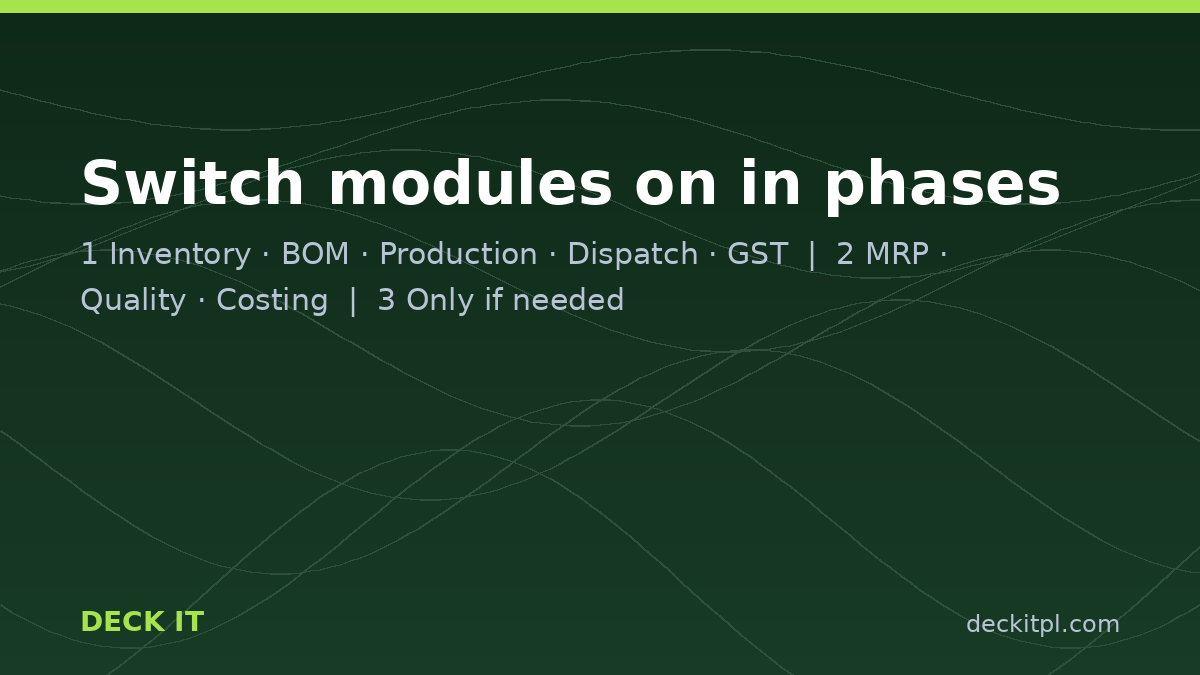
Here is the scope we recommend, split by when to switch it on.
| Area | What it must do | Phase |
|---|---|---|
| Item master and inventory | One code per item, batch or lot, stock by location | 1 |
| Bill of materials (BOM) | Parent-child structure, with versions when a design changes | 1 |
| Production orders | Issue material against an order, record output and scrap | 1 |
| Dispatch and invoicing | Delivery challan, GST invoice, e-invoice and e-way bill | 1 |
| Purchase | Purchase orders, goods receipt, supplier bills matched to receipts | 1 |
| Job work | Track goods sent out and received back, by challan | 1 or 2 |
| MRP | Turn orders and BOMs into a material shopping list | 2 |
| Quality control | Incoming, in-process and final checks with rejection reasons | 2 |
| Costing | Cost per order from material, labour and overhead | 2 |
| Maintenance, multi-plant, forecasting | Only if a real problem demands it | 3 |
Multi-level BOMs with versioning and MRP runs are standard requirements on manufacturing checklists (ERP Research). The point of the phase column is that you don't need all of it on day one.
Which compliance does an ERP for a Gujarat factory need?
It needs GST invoicing, e-invoicing and e-way bills built in, not bolted on. A factory that crosses the thresholds without them ends up keying the same invoice into the ERP and a government portal.
- E-invoicing. Mandatory above ₹5 crore aggregate turnover, counted across every GSTIN under the same PAN (Tally Solutions). From 1 April 2025, businesses with turnover of ₹10 crore or more cannot report an e-invoice more than 30 days after the invoice date (TaxGuru). Your ERP should generate the invoice reference number and QR code at the moment of billing.
- E-way bills. Movement of goods worth more than ₹50,000 generally needs one, with state-level exemptions that differ (ClearTax). Gujarat has a notification on intra-state movement (Gujarat Commercial Tax). Sources disagree on the details, so confirm current rules with your tax adviser before you configure anything.
- TDS. If you deduct tax on supplier payments, the ERP should compute it from the bill, not from a separate sheet.
- Job-work reporting. See the next section.
Thresholds change. We cite them as published in 2026, and you should check the GST portal for the current figure when you write your requirements.
How should an ERP handle job work?
It should treat job work as a stock location: material leaves your store on a challan, sits at the job worker, and returns as a processed item. Many Gujarat units send castings, plating, stitching or packing out to subcontractors, so this is rarely a side issue.
The GST rules put a clock on it. Inputs must return to the principal within one year and capital goods within three, otherwise the movement is treated as a supply (ClearTax). Principals who send goods without paying tax also file Form ITC-04. Blogs disagree on how often, so confirm the current frequency with the GST portal.
What the ERP needs to do:
- Raise a challan when material goes out, with the date it left.
- Show every open challan with days outstanding, and flag those nearing the limit.
- Receive finished goods against the challan and record the job-work charge and any scrap.
- Produce the data for the ITC-04 return.
If your ERP can't list open challans by age, you will find the overdue ones when someone audits you.
Why does ERP fail on the shop floor?
ERP fails on the shop floor because the people who generate the data weren't asked how the work flows. Vendor guides report that systems built without floor input miss simple things like defect logging, split-batch tracking and mobile screens, and operators decide "the ERP is not for us" (MIE Solutions).
Two other patterns show up repeatedly in Indian MSME reports. Heavy enterprise products overwhelm a small unit, and the floor quietly goes back to paper (Techlapse). And side spreadsheets survive because system data arrives late (Mirrorworks).
These are vendor-blog observations rather than controlled studies, but they match what we hear from factories.
What most ERP checklists leave out
Most checklists list modules. The scope that decides success is how data gets in.
- Who enters production output, and when? If a supervisor types the day's output at 6 pm from memory, your stock is wrong all day. Decide whether operators enter at the machine, a supervisor at shift end, or a barcode scan at the store.
- What does a screen cost in seconds? If recording a rejection takes eight clicks, it won't be recorded.
- Which reports does the owner actually open? Pick three: stock against reorder level, orders due this week, and pending job-work challans.
- What happens when the power or the network drops? Many industrial estates have patchy connectivity. Ask for offline entry or a fast way to batch-enter later.
Write these into the requirements document next to the module list.
Should a Gujarat manufacturing SME buy an ERP or build one?
Buy or configure an existing platform for the standard flows, and build only where your process is how you make money. Our guide to custom software vs off-the-shelf walks through that decision.
Clusters such as Rajkot for engineering and auto components, Morbi for ceramics and Ahmedabad for pharma and chemicals have quite different processes (Maritime Gateway). A ceramics unit tracks kiln batches and shade lots; a pharma plant tracks batch records. A generic module list can't tell you which of those matter to you.
On price, see our ERP implementation cost guide. Also check whether state support applies: the Gujarat MSME policy lists ERP among its technology-adoption assistance, but eligibility and scheme names change, so confirm with the MSME Commissionerate (ICAI MSME).
What we've seen at DECK IT
DECK IT is an Ahmedabad software company, founded in 2017, and we build business systems for Indian firms. The most common mistake we see in ERP scoping is the "everything" list: forty modules, no order, no owner. The project then drifts, and the floor never trusts the numbers.
What works better is a one-page flow map. Draw the five flows (inventory, BOM, production, dispatch, invoicing), mark where data is entered today, and decide who enters it in the new system. Only then compare platforms. If you want a second pair of eyes on a scope or a quote, our ERP consulting and implementation team does that, and our inventory management work covers the stock side on its own.
Frequently asked questions
What modules does a manufacturing ERP need?
At minimum: inventory, bill of materials, production orders, purchase, and GST invoicing with e-invoice and e-way bill. MRP, quality control and costing come next. Add maintenance and multi-plant features only when a real problem calls for them.
Do I need e-invoicing for my factory?
Yes, if your aggregate annual turnover exceeds ₹5 crore, counted across all GSTINs under one PAN (Tally Solutions). Below that, it isn't mandatory, but an ERP that supports it saves rework when you grow.
Does a small manufacturer need MRP?
Not on day one. MRP only works when your BOMs, stock and lead times are accurate. Run inventory, BOM and production orders for a few months first, then switch MRP on.
How should an ERP handle job work?
As a stock location with a challan for each movement, an age report for open challans, and data for the ITC-04 return. Inputs must return within one year and capital goods within three (ClearTax).
Can Tally replace an ERP for a manufacturer?
Tally handles accounts and basic inventory well. It doesn't plan production or track a BOM against shop-floor orders. If those are your pain points, you need ERP functions, whether in an ERP or alongside Tally.
Why do manufacturing ERP projects fail?
Mostly because the shop floor isn't involved, screens are too heavy, and data arrives late. Fix those in the scope, not after go-live.
Conclusion
Start with five flows: inventory, BOM, production orders, dispatch and GST invoicing. Add job-work tracking if you subcontract, and put data entry (who, where, how fast) in the scope next to the module list. Leave MRP, quality and costing for phase two.
If you'd like help turning your factory's flows into a scoped ERP plan, talk to DECK IT.