
Custom Software vs Off-the-Shelf: How to Choose
On custom software vs off-the-shelf, the rule is simple: buy off-the-shelf software when your process is common and your team is under about 20 users; build custom when the process is how you make money, or when per-user fees will keep climbing as you grow. Most Indian SMEs end up with a mix: ready-made software for the core, custom software for the one or two things that set them apart.
This guide gives you a way to decide: five questions to ask, a five-year break-even you can run with your own numbers, the hybrid option, and the mistakes we see Indian SMEs make on both sides.
- *Key takeaways**
- Of 7,835 Indian MSMEs surveyed in 2024-25, 53.8% use at least one digital tool and 46.2% are fully offline, so for many the first decision is simply "buy something" (India SME Forum).
- The top barriers Indian MSMEs name are high software cost, tight budgets, lack of tech skills and integration problems (Zoho survey of 5,149 MSMEs, via YourStory).
- Custom software typically costs 15–20% of its build price every year to maintain (MarsDevs).
- Per-user SaaS pricing compounds as you add staff; a common rule of thumb is that SaaS wins below 20 users and building starts to compete from 50 (MarsDevs).
What is the difference between custom and off-the-shelf software?
Off-the-shelf software is a finished product sold to many businesses, usually on a monthly per-user subscription or a licence. Custom software is built for one business around its own processes, and you own the result.
The practical difference is who adapts. With off-the-shelf software, your team adapts to the product. With custom software, the product is adapted to your team. Neither is better in general. The question is which adaptation costs you less.
| | Off-the-shelf | Custom | |---|---|---| | Upfront cost | Low | High | | Time to start | Days | Months | | Ongoing cost | Per-user fees, price rises | Maintenance, hosting | | Fit to your process | Good for common processes | Exact | | Who controls the roadmap | The vendor | You | | Main risk | Outgrowing it, lock-in | Over-building, a weak vendor |
When should an Indian SME buy off-the-shelf software?
Buy when the process is common, the team is small, and you need to be running within weeks. Accounting, email, payroll, basic CRM and project tracking are the usual cases, because thousands of firms run them the same way.
India also has strong, cheap ready-made options for exactly these jobs. As reported by third-party pricing trackers, TallyPrime Silver costs ₹22,500 plus GST for a single user (Patron Accounting), and Zoho Books starts at ₹749 a month on its Standard plan, billed annually and excluding GST (Patron Accounting). Prices change, so confirm on the vendor's page. Building your own accounting package to save a subscription like that is rarely a good use of money.
Buying also makes sense when you don't yet know your process. Software built around a process you are still inventing gets rebuilt. Use a packaged tool for a year, learn what you actually need, and decide then.
When should an Indian SME build custom software?
Build when the process is how you make money, when no product fits without heavy workarounds, or when you are paying for many seats of something you use at a fraction of its capacity. Your own pricing logic, a dispatch or booking flow, a regulated workflow, or a customer portal that is part of your product are typical examples.
Three signs it is time:
1. Your team keeps a spreadsheet beside the software to do the part the software can't. 2. You have integrated three or more tools with manual re-keying between them. 3. A vendor's price rise or product change has more than once forced your hand.
Custom is also a fit when you want to own the data model. Moving off a SaaS product later usually means exporting what the vendor lets you export; with your own system the database is yours from day one.
How do you work out the real cost over five years?
Compare five-year total cost, not the first invoice. Software cost is spread across years, and the two options spread it differently: SaaS is a steady, growing bill, while custom is a large payment up front and a smaller bill afterwards.
Use this formula:
- Off-the-shelf, 5 years = users × price per user per month × 12 × 5, plus setup, training and add-ons
- Custom, 5 years = build cost + (maintenance rate × build cost × 5) + hosting
Here is an illustration, with assumptions stated so you can swap in your own. Take a CRM at ₹1,400 per user per month, the annual Professional price reported for Zoho CRM in India, excluding 18% GST (ITforSME). Assume a custom equivalent costs ₹25 lakh to build (our assumption, not a quote) and 15–20% a year to maintain (MarsDevs).
| Users | SaaS, 5 years | Custom, 5 years (₹25L build) | |---|---|---| | 20 | ₹16.8 lakh | ₹43.8–50 lakh | | 60 | ₹50.4 lakh | ₹43.8–50 lakh | | 100 | ₹84 lakh | ₹43.8–50 lakh |
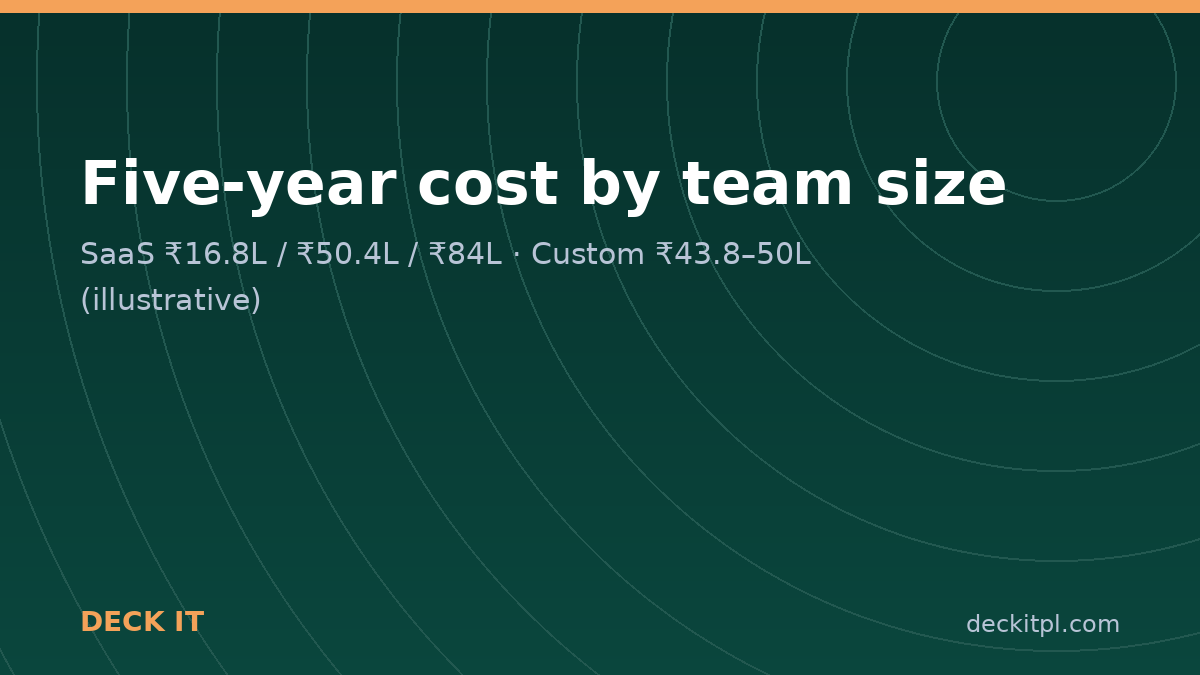
At 20 users, SaaS is far cheaper. Around 60 users the two meet, and beyond that custom is cheaper on paper. The table leaves out hosting, SaaS price rises, add-ons and the fact that a ₹25 lakh build may not match a mature product feature for feature. It shows the shape of the curve, not your answer. For build prices by project type, see our custom software development cost guide.
Why does customising off-the-shelf software go wrong?
Customising a packaged product heavily tends to give you the costs of both options. You pay build prices, you stay tied to the vendor's upgrade cycle, and every upgrade can break your changes.
This is well documented for ERP. One industry summary cites over-customisation as a factor in 23% of failed ERP projects (Godlan), a secondary figure we could not verify against the original study. The advice that follows is consistent across ERP vendors: configure first, customise sparingly, and change the process before you change the product.
A useful test: if you need to customise more than about a fifth of what the product does, the product is not the right fit. Either change your process or build.
Is a hybrid approach better?
For most SMEs, yes. Buy the commodity parts and build only what differentiates you, connected through APIs.
A typical hybrid looks like this: Tally or Zoho Books for accounts, a packaged HR tool for payroll, and a custom operations system for the part of the business no product handles well. The custom piece stays small, so build cost and maintenance stay small too.
The catch is integration. Every connection between systems needs maintaining, and Indian MSMEs already name integration as a top barrier (Zoho survey, via YourStory). Ask any vendor, ours included, which systems they will connect and who fixes it when a connection breaks.
Five questions to answer before you decide
1. Is this process common or unique? Common: buy. Unique and money-making: build. 2. How many users in three years? Under 20: lean buy. Over 50: run the break-even. 3. How many other systems must it talk to? Many integrations favour custom or a hybrid. 4. Who will own it internally? Both options need a named owner. No owner means failure for either. 5. Can you afford the first year? Custom front-loads cost. If cash is tight, start with a product.
What we've seen at DECK IT
DECK IT has built custom software from Ahmedabad since 2017, and we also sell ready-made products, including a Hospital Management System and a Hotel Management System. That means we have no reason to push you one way. For many clients the honest answer is a product plus a small custom layer.
Where we do recommend building is where the software is the business: a custom web application built around a workflow that products handle badly. Where a ready-made product already covers 80% or more of what you need, we say so. A good vendor should tell you when not to hire them.
Frequently asked questions
Is custom software better than off-the-shelf software?
How many users before custom software becomes cheaper than SaaS?
Is custom software more expensive than off-the-shelf in India?
Can I customise off-the-shelf software instead of building from scratch?
Can we start with off-the-shelf and move to custom later?
What is the biggest risk of custom software?
Conclusion
Start with the process, not the technology. If it is common, buy a product and move on. If it is yours alone, price a build and compare five-year totals. If it is both, do both: buy the core and build the edge.
If you want a second opinion on your case, we'll tell you plainly whether you need a build at all.